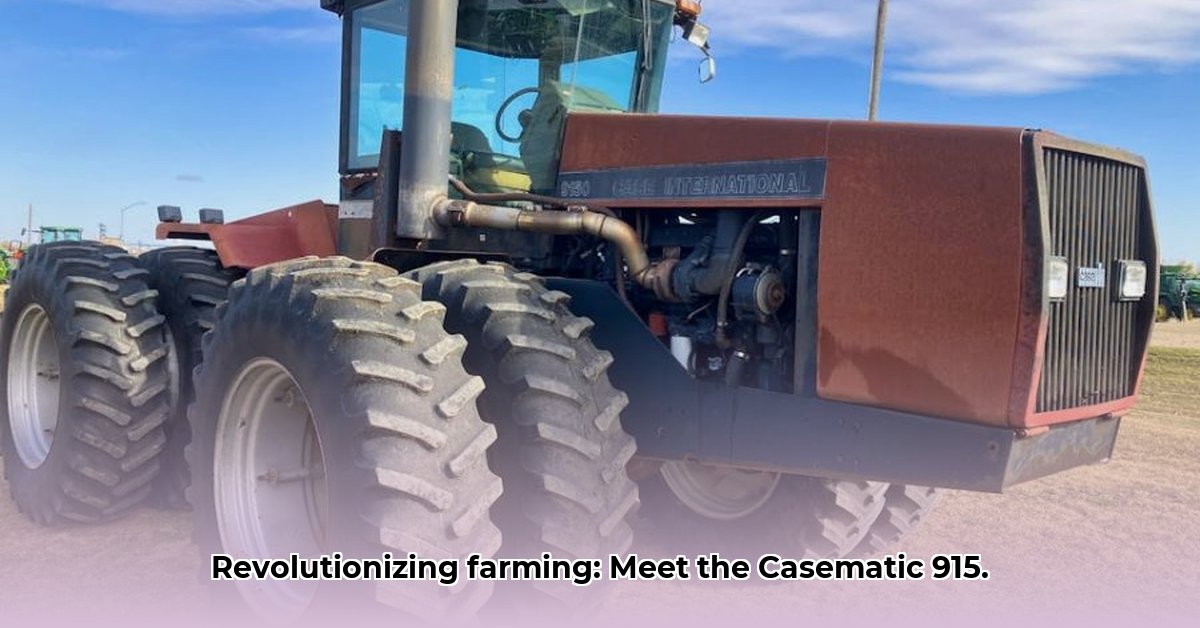
Tractor Casematic 915: A Sustainable Farming Solution?
The Case IH Casematic 915 isn't a high-tech marvel; it's a reliable workhorse ideally suited for smaller to mid-sized farms. This review explores whether its dependability translates to a truly sustainable solution for modern agriculture. This analysis considers performance, maintenance, environmental impact, and comparisons with modern tractors, offering actionable advice for various stakeholders. For more Case tractor models, see the Case Tractor Models page.
Performance and Capabilities: A Workhorse for Smaller Farms
The Casematic 915 boasts approximately 80-100 horsepower (hp), sufficient for various tasks on smaller farms, from plowing to operating implements. While precise fuel efficiency data is scarce, user reports suggest respectable fuel economy relative to newer tractors. Its smooth-operating transmission minimizes fuel waste and wear. Its compatibility with different implements makes it adaptable to diverse farming methods and crops. However, its horsepower may be insufficient for large-scale operations or heavy-duty tasks. Farmers should carefully assess their needs before purchasing. Isn't maximizing efficiency a key element of sustainable farming?
Maintenance and Reliability: Keeping Costs Down
The Casematic 915's simple design significantly reduces maintenance costs and downtime. This translates to long-term cost savings and more time in the fields, less time in the shop. "The simplicity of the Casematic 915 is a major advantage," states John Miller, Farm Manager at Miller Family Farms, highlighting the reduced need for specialized repairs. This inherent simplicity contributes to environmental sustainability by minimizing resource consumption in manufacturing and maintenance.
Sustainability Assessment: A Nuanced Look
The Casematic 915's diesel engine contributes to emissions. However, its long lifespan significantly reduces the overall environmental impact compared to more frequently replaced modern tractors. Fewer replacements mean less resource consumption and less waste in landfills. The tractor's simple design inherently uses less material than many modern counterparts, further benefiting the environment. While diesel isn't eco-friendly, the trade-off between emissions and resource consumption over its prolonged lifespan deserves careful consideration. Ongoing research continues to assess this complex dynamic. Does the longevity outweigh the emissions?
Comparing the 915 to Modern Tractors: Technological Gaps
Modern tractors offer GPS guidance, automated steering, and yield monitoring systems, features absent in the Casematic 915. This doesn't render it obsolete, but it does limit efficiency gains. The crucial question is whether retrofitting these features justifies the cost. This decision depends entirely on individual farm operations and budgets. Could a targeted upgrade be a more sustainable solution than replacing the entire machine?
Actionable Advice: Putting the 915 to Work
The Casematic 915 excels in a specific niche. Understanding this niche is key to maximizing its contribution to sustainable practices.
Table: Actionable Steps for Different Stakeholders
| Stakeholder | Recommended Actions |
|---|---|
| Small-scale farmers | Carefully evaluate used 915s; commit to a regular maintenance schedule. |
| Medium-scale farmers | Assess workload; consider targeted upgrades if justified. |
| Equipment Suppliers | Maintain parts stock; explore sustainable parts sourcing. |
| Policy Makers | Incentivize sustainable technology upgrades and environmentally responsible parts production. |
Risk Assessment (Simplified):
Preventive maintenance is crucial to mitigate potential risks.
| Component | Potential Risk | Mitigation Strategy |
|---|---|---|
| Diesel Engine | Emissions, breakdowns | Regular maintenance; explore biofuel options (where feasible). |
| Transmission | Wear and Tear | Regular fluid changes and preventative inspection |
| Hydraulic System | Leaks | Regular inspection and prompt repair of any issues |
| General Mechanical Wear | Breakdowns | Preventative maintenance, regular inspections |
Conclusion: A Sustainable Choice for Some
The Casematic 915, despite its limitations, presents a viable sustainable option for smaller-scale farms valuing dependability and cost-effectiveness. Its longevity and simple design offer a compelling alternative to the trend toward increasingly complex machinery. Its legacy lies in its potential to contribute to a sustainable farming model for appropriate operations. Its simplicity is, in itself, a form of environmental responsibility. Is simplicity sometimes the most sustainable solution?